
How to Choose the Right Greenhouse PE Film
Greenhouse film plays an important role in controlling light, temperature, humidity, and the growing environment.
Choosing the right greenhouse PE film can affect film service life, light transmission, crop conditions, and greenhouse operating costs.
However, the ideal film specification depends on local climate, greenhouse structure, crop type, and expected service period.
Four Key Greenhouse Film Properties
- Film Thickness
Common greenhouse PE film thicknesses may range from approximately 0.08 mm to 0.15 mm, depending on the application.
A thinner film may be suitable for certain seasonal applications, while thicker film can provide additional mechanical strength and durability.
The correct thickness should be selected according to:
Greenhouse structure
Local wind conditions
Installation method
Expected service life
Crop requirements
Thicker does not automatically mean better.
- Light Transmission
Light transmission directly affects the amount of sunlight entering the greenhouse.
High-transmission greenhouse film can help maximize available light for photosynthesis.
For crops with specific light requirements, buyers may also consider specialty films designed for light diffusion or other optical characteristics.
- UV Resistance
Ultraviolet radiation can accelerate polymer degradation.
UV stabilization can help slow the aging process and extend the useful service life of greenhouse film.
When purchasing agricultural film, ask suppliers for information about:
UV stabilization
Accelerated aging tests
Expected service conditions
Recommended replacement cycle
4. Thermal and Anti-Drip Properties
For cold-weather cultivation, thermal performance can help reduce heat loss.
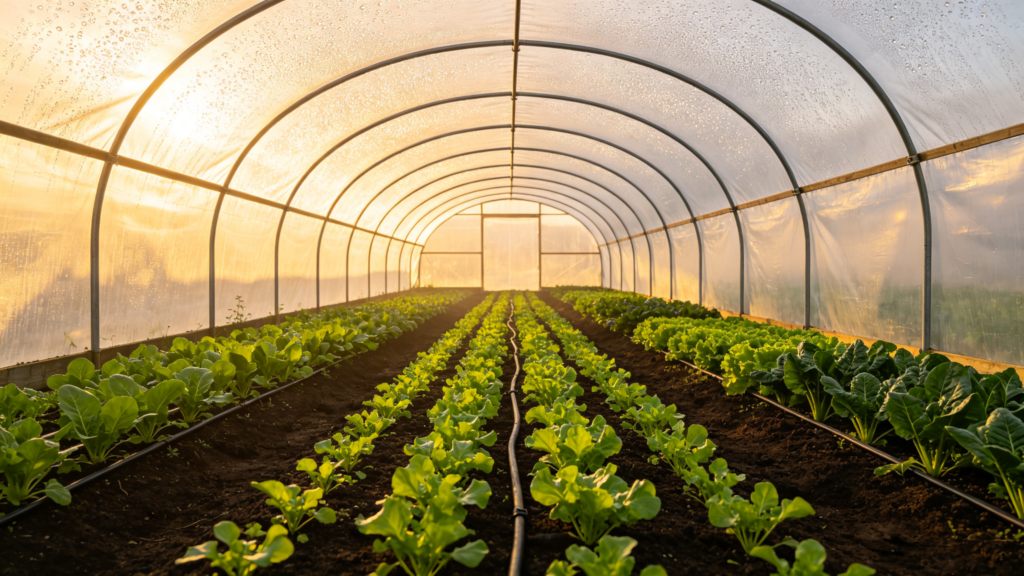
Anti-drip or anti-condensation properties can also be valuable because water droplets on the inner surface can affect light transmission and greenhouse conditions.
Choosing Film for Different Crops
Vegetable Greenhouses
Vegetable production may prioritize light transmission, durability, thermal performance, and condensation control.
Winter Greenhouses
Winter applications generally require stronger consideration of insulation, UV resistance, and long-term durability.
Flower and Nursery Production
Some crops may benefit from films with specialized optical properties, such as light diffusion.
Windy Regions
Areas with strong winds may require film with greater tensile and puncture resistance.
Greenhouse Film Purchasing Checklist
Before ordering, ask your supplier about:
Thickness
Light transmission
UV stabilization
Anti-drip performance
Film width
Roll length
Expected service life
Test reports
Recommended climate conditions
FAQ
Why does greenhouse film become yellow and brittle?
UV exposure, high temperature, oxidation, and insufficient stabilization can contribute to film aging.
How long does greenhouse PE film last?
Service life varies according to formulation, thickness, UV exposure, climate, installation, and greenhouse conditions. Long-life agricultural films are designed for extended outdoor use, but actual performance should be verified with product data.
Can old greenhouse film be recycled?
PE agricultural film can enter appropriate polyethylene recycling streams where collection and recycling infrastructure is available.
MUTONG INDUSTRY Agricultural Film
MUTONG INDUSTRY supplies agricultural PE film solutions for greenhouse and farming applications.
Film specifications can be customized according to width, thickness, optical requirements, UV resistance, and application conditions.
For agricultural projects, providing local climate and crop information can help determine a more suitable film specification.